
How to Quickly Identify a Taiwan-Based Hand Tool Manufacturer: A Quick Reference Guide
In recent years, the "Made in Taiwan" label in the international hand tool market has become both increasingly expensive and increasingly ambiguous. While many
products are labeled MIT, industry insiders know that Taiwan's greatest risk today is not being replaced by China, but having its value diluted by suppliers that merely "look like" they are Taiwanese-made. For international brands, the inability to distinguish
between actual manufacturers and trading companies leads to consequences that go beyond pricing—impacting quality, accountability, and long-term reputation.
- Forging (heavy equipment, noise)
- Heat treatment (high-temperature process)
- Electroplating (wastewater treatment)
- Mid-to-high range
- Professional-grade
- High-mix, low-volume
If a supplier: Extremely low price, Low minimum order quantity (MOQ), Customization: "We can do anything"
But cannot explain it clearly, like Material, Tolerance, Structural design.
3.) Ask about the source of the steel
When discussing materials, authentic Taiwanese manufacturers will almost always mention:
China Steel Corporation (CSC)
Because:
- Consistent batch quality
- Transparent chemical composition
- Consistent heat treatment quality
You can ask it directly like this "Could you provide the raw material certification?"
Authentic "Made in Taiwan" products will provide you with: Mill Sheet, heat number, and chemical composition ratios.
Products falsely claiming to be "Made in Taiwan" usually say "This is made of alloy steel; Our quality is guaranteed"
5.) Do they hold any patents?
Taiwanese factories typically hold utility patents and invention patents (for structural design improvements)
For example:
- Improved torque mechanism
- Specialized ratchet design
If a company claims to have "30 years of manufacturing experience" but you can't find a single patent to their name, you should probably think twice.
6.) Delivery lead times and MOQs are actually very telling
Authentic Made in Taiwan:
- Standard lead times are rarely as short as one month
- There is a minimum order quantity (MOQ) requirement
- They will discuss the production schedule with you
If someone tells you "Two weeks is all it takes! Super affordable even for small quantities! In stock and ready to ship!!" That looks more like a warehouse than a factory.
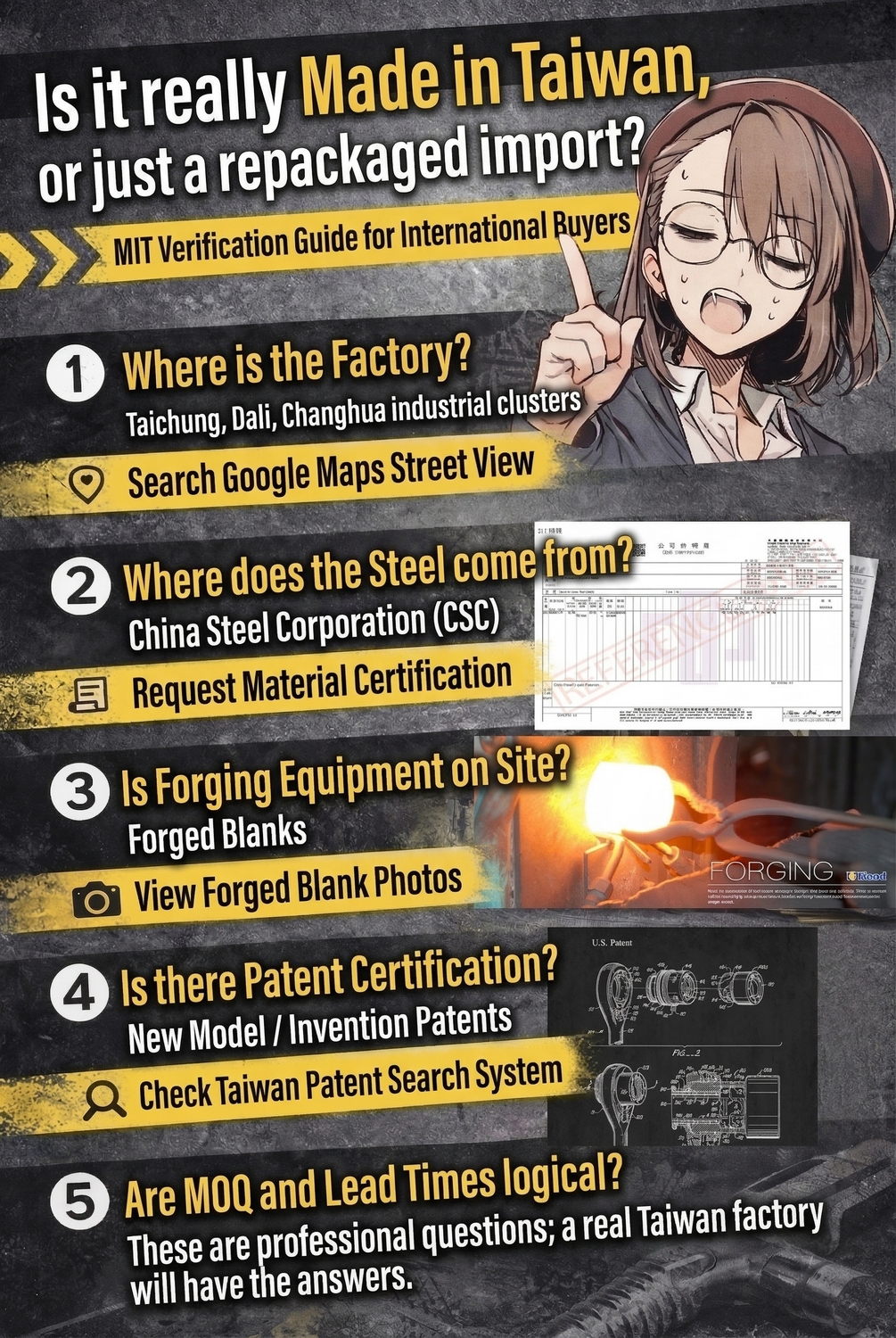
Quick reference guide for evaluation
1.) Where is the factory located?
2.) What is the source of the steel?
3.) Do they have forging or CNC capabilities?
4.) Does the company have its own patents or R&D capabilities?
5.) Are the MOQ and lead time reasonable?
The more specific the answer, the better.
Ultimately, the value of Taiwanese hand tools lies not in their low price, but in the fact that you know exactly how they are made.
Authentic Made in Taiwan, ready to stand up to any question you have.
If you are International buyers, brand owners, and OEM clients, I hope you find this article helpful, as market standards will only continue to become more stringent in the future.