Looking for a Quality Hand Tool Manufacturer in Taiwan? 3 Point for Choosing the Right OEM Partner
The Quiet Revolution in the U.S. Hand Tool Market: Pressure on U.S. Manufacturing and the Reshaping of Overseas Supply Chains
Before discussing how to select a high-quality partner, we must first understand the major changes in the global sourcing environment in 2026. Over the past few years, the U.S. market has undergone a rapid transformation in the hand tool industry. This has changed consumer purchasing choices and reshaped the supply-chain strategies of global brands.
What Is the Current Reality—and Challenge—of “Made in USA”?
For decades, Made in USA has represented quality and local identity in the hand tool sector, commanding a meaningful brand premium. However, global inflation, sharply rising U.S. labor costs, and a shortage of skilled workers have put the traditional all-domestic manufacturing model under severe pressure.Many U.S. brands have found that domestic production lines alone cannot absorb high operating costs or respond to seasonal surges in demand. Under the dual pressure of tightening margins and delayed delivery, U.S. manufacturing cannot be regarded as a single, stable long-term solution.
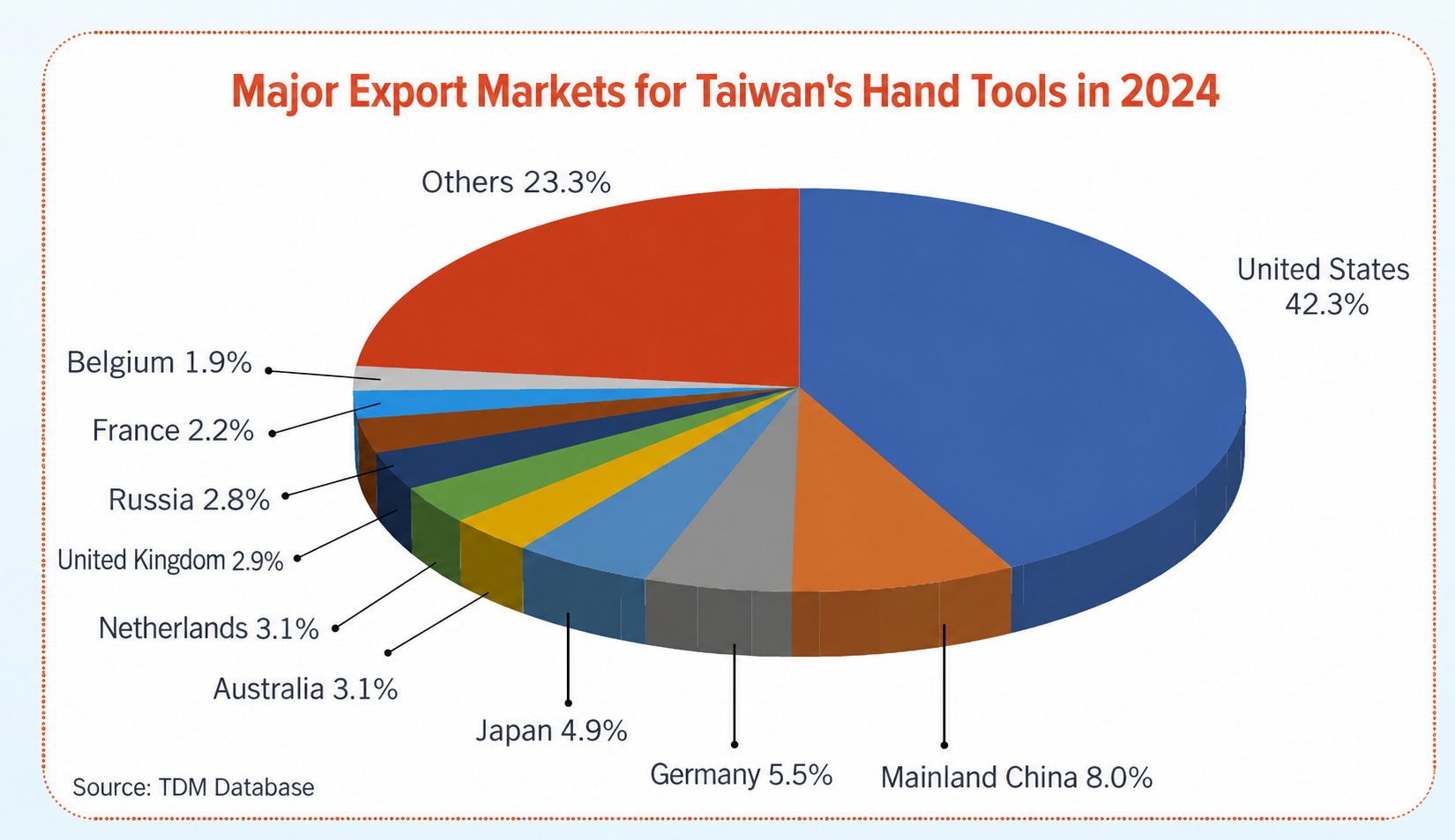
Why Has Taiwan’s Supply Chain Become the International First Choice Amid Strong Demand for Premium Tools?
As tariff barriers have intensified in the post-pandemic era, Taiwanese hand tool factories have filled the gap in U.S. domestic capacity through rigorous material traceability, excellent heat-treatment processes, and in-house tooling development. They have become the optimal solution for international brands seeking both consistent quality and predictable costs.
Why Do International Brands Rely So Heavily on Professional OEM Partners?
Among all hand tool categories, impact sockets in particular demand exceptional strength and durability. International brands conduct rigorous, long-term evaluations to determine whether a supplier has sufficient manufacturing capacity and supply-chain management capabilities to provide theseimpact sockets.
Take impact sockets used with heavy-duty power tools as an example.
Their raw material is Chrome-Molybdenum (Cr-Mo) alloy steel from Taiwan’s China Steel Corporation, with transparent and traceable sourcing. Manufacturing combines large-scale hot forging and press forging that meet ANSI and DIN standards, high-efficiency cold-forging
equipment, box-furnace heat treatment for gear-grade wear resistance, and structural designs that help prevent cracking under high-speed impact.
For all of these reasons, Tien-i can confidently say: “Taiwan-made impact sockets will consistently meet customer expectations, regardless of the year or month in which they are manufactured.”
Do Best-Selling Hand Tools Come from Taiwan?
Taiwan’s contract-manufacturing system has a mature and tightly
connected supply-chain ecosystem. It offers one-stop services ranging from design for manufacturability (DFM) and patented structural development to rigorous in-house testing, enabling brands to rapidly turn real-world technician needs into market-proven,
high-demand tools. This has become a secret weapon for major U.S. brands to stay ahead in a fiercely competitive market.
How to Evaluate a Hand Tool OEM Manufacturer: Key Criteria
Finding a factory willing to take an OEM order is not difficult; finding a tool manufacturer that can deliver consistently over the long term is. When selecting a hand tool OEM partner, many brands focus only on the quoted price, only to encounter the nightmare of inconsistent quality and delayed delivery during mass production.
Material Verification and Steel Traceability: The Foundation of High-Strength, Durable Tools
The quality of hand tools—especially impact tools that must withstand high torque and impact forces—depends heavily on the steel used. Professional hand tool OEM manufacturers typically establish comprehensive material verification and traceability systems, selecting the appropriate material for each application. For example, hand sockets commonly use chromium-vanadium (Cr-V) steel, while high-impact sockets often use tougher Chrome-Molybdenum (Cr-Mo) alloy steel. Spectrometers are then used to verify the elemental composition.
Each incoming batch of steel is assigned a lot number. Complete records are retained from the steel mill through forging, heat treatment, and finished goods, making both material sources and manufacturing processes traceable. This also helps ensure consistent hardness, torque performance, and service life from batch to batch.
An Attractive Sample Does Not Guarantee Trouble-Free Mass Production
A trustworthy Taiwanese socket-set OEM factory should have comprehensive in-house testing equipment capable of completing most demanding
inspections before shipment:
Torque and Ultimate Failure Testing:
Does the factory have a range of torque testers and universal testing machines to verify whether products meet or exceed ANSI (American National Standards Institute) and DIN (German Institute for Standardization) torque requirements?
Hardness and Metallographic Analysis:
Rockwell hardness testers and metallographic microscopes are used to examine the case depth and internal grain structure after heat treatment, ensuring that the tools are hard without becoming brittle.
Surface Treatment and Corrosion-Resistance Testing:
Salt-spray testers and coating-thickness gauges verify the corrosion resistance of plating, phosphating, black oxide, and other surface treatments, ensuring that products can withstand long-term use in harsh industrial environments.
Why Taiwan?
As global supply chains are being reshaped, many internationally recognized brands seeking premium tool manufacturing ultimately turn to Taiwan. Why has Taiwan earned its reputation as the “Kingdom of Hand Tools” and become the safe, trusted OEM choice recognized by international buyers?
Advantage 1 | A Complete and Highly Concentrated Industrial Cluster
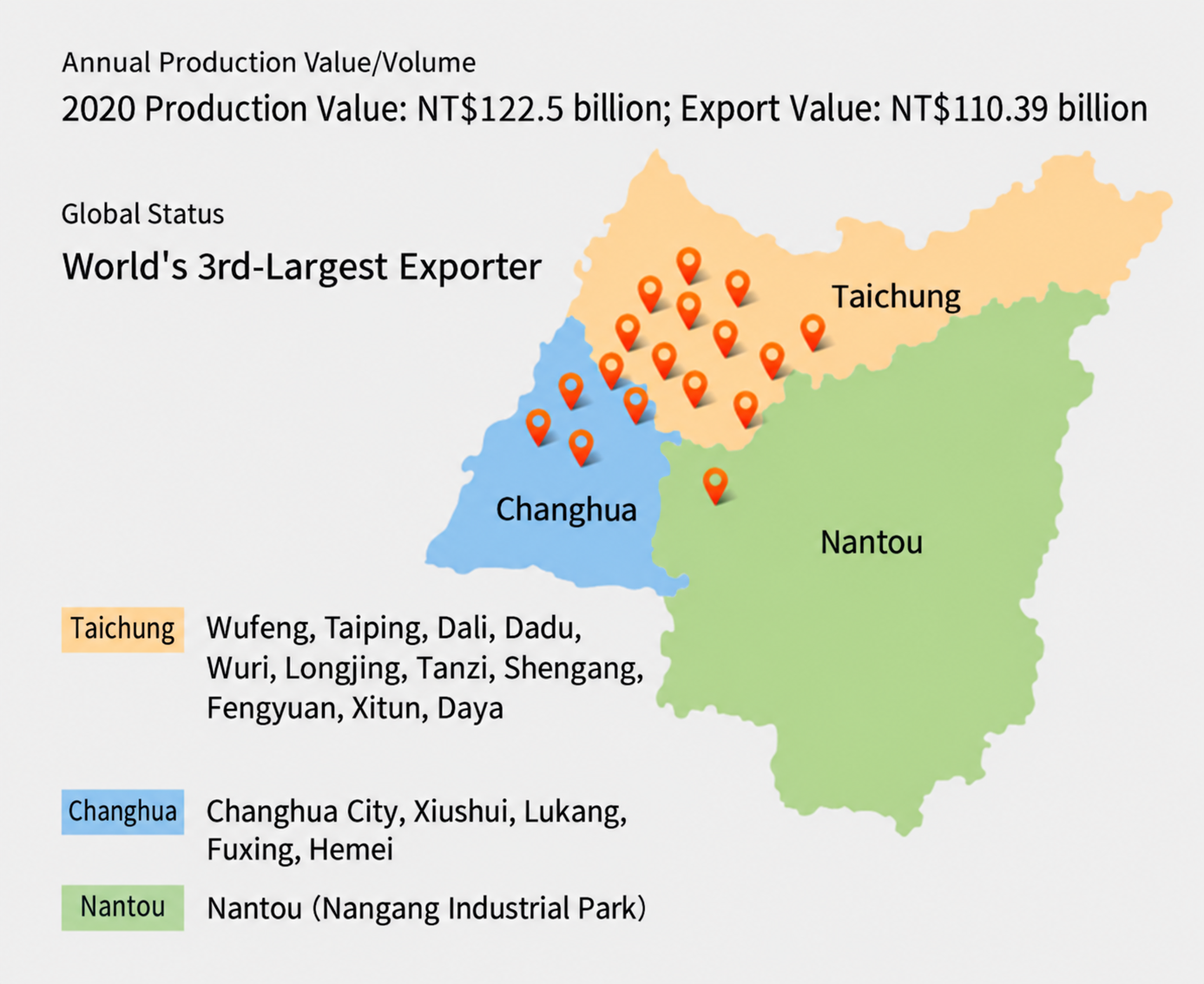
Taiwan has a highly concentrated hand tool industrial cluster that is rare worldwide. From material supply, tooling development, and forging to precision CNC machining, heat treatment, surface plating, and packaging, the entire supply chain is closely linked within a few dozen kilometers across Taichung and Changhua. This concentration enables tool OEM manufacturers to coordinate across processes in the shortest possible time, significantly shortening sampling and new-product development cycles.
From tooling development, forging, and precision machining to heat treatment and surface finishing, the hand tool industry’s responsiveness depends on a complete surrounding ecosystem. Individual manufacturing processes are fundamental, but the real core is the ability to rapidly adjust production lines, introduce new materials, and accommodate new specifications.
Whether for high-specification insulated tools, aerospace-grade torque wrenches, or digital hand tools with integrated IoT sensors, international brands continue to choose Taiwan when moving into volume production. Taiwanese hand tool companies focus on contract manufacturing and collaborative R&D rather than competing with their brand customers. Their value lies in helping customers reduce the cost of trial and error and bring designs into mass production.
Even with market access and design advantages, European and U.S.
brands cannot easily rebuild a complete ecosystem encompassing tooling, forging, heat treatment, and surface finishing in a short time. Leveraging Taiwan’s mature ODM integration capabilities and flexible manufacturing systems is the key path for global tool
brands to rebuild supply chains while maintaining quality and delivery efficiency.
Advantage 2 | Exceptional Metalworking and Heat-Treatment Expertise
Taiwan’s hand tool industry has developed for more than half a century,
accumulating extensive practical knowledge and expertise in metalworking and heat treatment.
Extensive Heat-Treatment Expertise:
The service life of sockets and impact tools depends on heat treatment. Taiwanese heat-treatment facilities also process parts for aerospace, industrial, military, and energy applications. This decades-long experience gives them a deeper command of precise
quenching and tempering control, enabling tools to achieve an optimal metallurgical condition: hard without brittleness, with high toughness and impact resistance.
Consistent Daily Quality Control and Data-Driven Management:
ERP systems, inspection equipment, and ISO quality management systems are widely adopted in Taiwan.
Smart Manufacturing and Automation:
Thanks to Taiwan’s mature supply chain for advanced automation equipment, many Taiwanese socket factories have gradually introduced intelligent production lines. This not only improves product consistency but also effectively reduces human error and defects.
Advantage 3 | A Non-Competing Partner
For international customers that invest seriously in building their brands, the leakage of patented technology and the copying of trade secrets are their greatest nightmares. Taiwan’s high standards in the rule of law and intellectual-property protection are central reasons why major international brands can place orders with confidence.
Taiwanese hand tool OEM factories generally avoid conflicts of interest with their customers. They do not sell identical products alongside their customers through e-commerce platforms or other third parties, nor do they use unauthorized development to sell dedicated tooling to third-party customers. This is essential to protecting the foundation for long-term cooperation.
They remain committed to pure contract manufacturing and collaborative R&D, without operating their own brands. As non-competing, long-term partners focused on the manufacturing backend, Taiwanese companies strictly protect their customers’ patented technologies and trade secrets. Their value lies in helping brand customers reduce trial-and-error costs and bring designs into production.
Taiwan is both capable and non-threatening as a partner!
Choose Tien-i: A Trusted Strategic OEM Partner for Taiwanese Hand Tools
From Taichung to Changhua, steel, forging, heat treatment, CNC
machining, grinding and polishing, surface finishing, plastic molding, EVA, packaging, and quality testing together form a hand tool ecosystem with short distances, fast response times, and mature specialization. In an industry that values safety, durability,
precision, and cost, individual process expertise is important, but even more important are the abilities to learn quickly, integrate across processes, and identify and solve problems before mass production.
Whether the product is an extra-thin or extra-long socket, an extraction tool, a high-torque ratchet, an air chisel, a new material
or surface treatment, or a highly customized tool set and package, Taiwan’s mature supply chain remains difficult to replace when a product must move from concept to drawing, from a tested sample to stable mass production.Comprehensive
customization services can be tailored to brand requirements, from blow-molded case design and laser engraving to two-color storage foam and master-carton packaging. Support is also available for shipping requirements across North America, Europe, the Asia-Pacific
region, and other markets. These are key reasons why Tien-i is a long-term manufacturing partner for brands expanding overseas.
Tien-i Industrial has cultivated expertise in Taiwan’s hand tool, power tool, and pneumatic tool manufacturing industries for more than 20 years. We do more than manufacture to drawings: we work with brands to balance performance, quality, cost, MOQ, lead time, and mass-production risk, turning market needs into products that can be delivered reliably.
Tien-i does not compete with its customers in the market; instead,
it is a trusted manufacturing partner behind their brands. Taiwan is a non-competing partner—and a highly capable one.