2026/03/22
Hand Tools Knowledge and Resource
Using Stainless Steel To Make Hand Tools?
When most people think of stainless steel, the first grades that come to mind are AISI 304 or AISI 316.
However, when it comes to hand tools, material selection cannot be based solely on the material grade.
The factors that truly influence material selection typically include material properties, manufacturing processes, and the actual conditions under which the final product will be used. In other words, the choice of material
isn't based on what is most common, but rather on what is best suited for the hand tool's intended end use.

How to select stainless steel for hand tools:
Types of stainless steel
Stainless steel is not a single material; rather, it can be classified into several main categories:
1. Austenitic stainless steel
Martensitic stainless steel
3. Ferritic stainless steel
4. Precipitation-hardening stainless steel
5. Duplex stainless steel
Super austenitic stainless steel
Are you looking for forging or casting?
When evaluating materials for most hand tools, the process typically begins by considering forging requirements.
Common representative steel grades include:
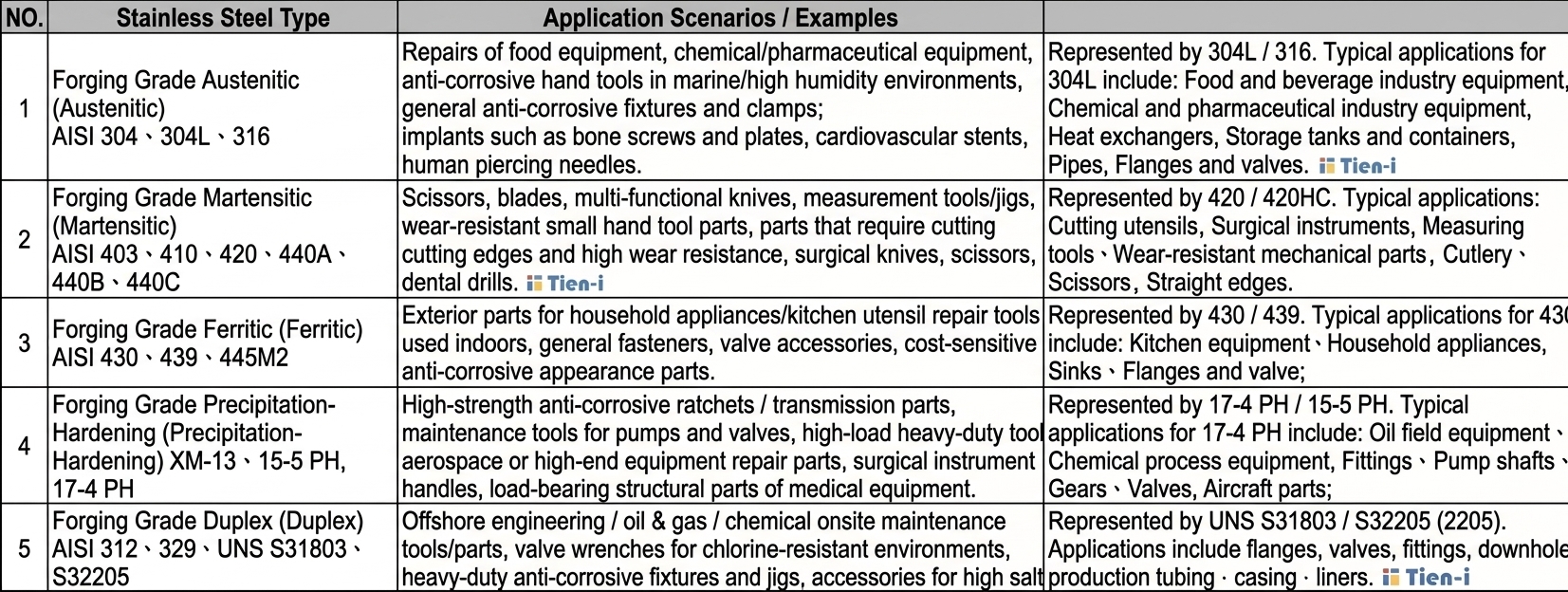
• Austenitic stainless steel for forging purposes
AISI 304, 304L, and 316 stainless steel
• Martensitic stainless steel for forging
AISI 403, 410, 420, 440A, 440B, and 440C
• Ferritic stainless steel for forging
AISI 430, 439, and 445M2
• Precipitation hardening for forging applications
XM-13, 15-5 PH, and 17-4 PH
• Duplex stainless steel for forging
AISI 312, 329, UNS S31803, S32205, and others
Key considerations for using stainless steel in hand tools:
1.) Will the user be using these stainless steel tools in an environment containing chlorides? (e.g., hand tools for ship repair?)
Special attention is required if the tools will be used in environments containing salt or chlorine.
Materials such as duplex stainless steel offer superior resistance to the following issues:
• Stress corrosion cracking
• Pitting corrosion
Consequently, it is commonly used in applications such as offshore structures and desalination equipment.
2.) Will it be used in high-temperature environments?
The hardness and toughness of certain stainless steels decrease significantly when used at high temperatures.
3.) Is welding required?
If the rear section of the component requires further welding, the welding filler metals must be evaluated alongside the base material.
For example, common equivalents include:
AWS E308, AWS E309, AWS E316, AWS E410, AWS E430, and AWS E630
4.) The drawing specifies AISI, while the customer's documentation specifies EN or SUS
This is a common scenario for hand tools intended for export.
Engineering, procurement, and clients often use different specification names that may appear to refer to different materials, even when they are actually pointing to the same type of steel.
Therefore, material selection involves not just the material itself, but also the conversion of specifications. Clearly cross-referencing AISI, EN, and SUS standards is essential to minimize communication gaps.
5.) Can the HRC of stainless steel be increased through heat treatment?
The specific heat treatment conditions for different types of stainless steel determine whether they are suitable for creating "working ends" that require high torque and high wear resistance.
Austenitic 300 series: SUS304/SUS316
The 300 series is classified as austenitic stainless steel, known for its excellent corrosion resistance and good machinability and weldability; however, it cannot be hardened through heat treatment. In other words, it is
very difficult to manufacture a high-HRC working end, such as a chisel tip, using this material.
Among these, 316/316L offers superior corrosion resistance in chloride-rich environments due to its molybdenum (Mo) content. However, material specifications clearly warn that pitting and crevice corrosion can still occur
in warm, chloride-rich environments, and it is subject to stress corrosion cracking at high temperatures. While often referred to as "marine grade," it is specifically noted that it is not resistant to "warm seawater."
Martensitic 400 series: SUS420, SUS440C, etc
The 400 series consists of both ferritic and martensitic grades. For hand tools, which require high hardness, the martensitic grade is typically preferred because it can be heat-treated to achieve high strength and wear resistance
through a higher carbon content; however, this often comes at the expense of lower corrosion resistance compared to the austenitic series.
Taking 420 stainless steel as an example, the material specifications clearly state that it is a hardenable
martensitic stainless steel capable of reaching at least 50 HRC, with "hand tools" listed among its applications. Compared to common austenitic grades, its corrosion resistance is lower, and optimal corrosion resistance is typically achieved in a "hardened
and surface-ground or polished" state.
420HC has a typical chemical composition of approximately 12.5-13.5% Cr and 0.4-0.45% C, with a hardness reaching 40-52 HRC; it is a representative grade that balances both corrosion resistance and hardness.
440C is described as a high-carbon martensitic stainless steel that achieves exceptionally high hardness
and wear resistance compared to similar stainless steels after heat treatment. Its typical applications include high-quality blades, surgical instruments, and chisels. The table lists its HRC values at various tempering temperatures, which range from approximately
56 to 59 HRC.
SUS403 and SUS431 are among the stainless steel options with superior heat resistance. A quick tip: if you
are using hand tools near heat sources—such as around engines, heat exchangers, or during high-temperature equipment maintenance—be sure to factor "heat resistance" into your choice of material grade.
Precipitation-hardening (PH) 17-4PH stainless steel: SUS630
PH stainless steel is positioned to balance high strength and hardness with excellent corrosion resistance. For example, 17-4PH H900 achieves a hardness of 40-48 HRC.
Its corrosion resistance is comparable to that of 304 stainless steel. This makes it highly practical for tool components that require both high strength and corrosion resistance, such as shafts, pins, and load-bearing connectors.
Why are stainless steel hand tools so uncommon?
Due to considerations regarding the hardness, durability, and processing costs of various types of stainless steel, it is rarely the optimal choice.
While it is possible to manufacture hand tools from stainless steel, it is rarely the most cost-effective solution for general industrial use. Stainless steel tools are primarily used in specialized environments—such as food processing, pharmaceuticals, biotechnology, laboratories, cleanrooms, maritime operations, and stainless steel equipment assembly—where there is a critical need to prevent contamination and rust, or where the tools must withstand frequent cleaning, sterilization, and corrosive conditions.
Stainless Steel Application Chart: